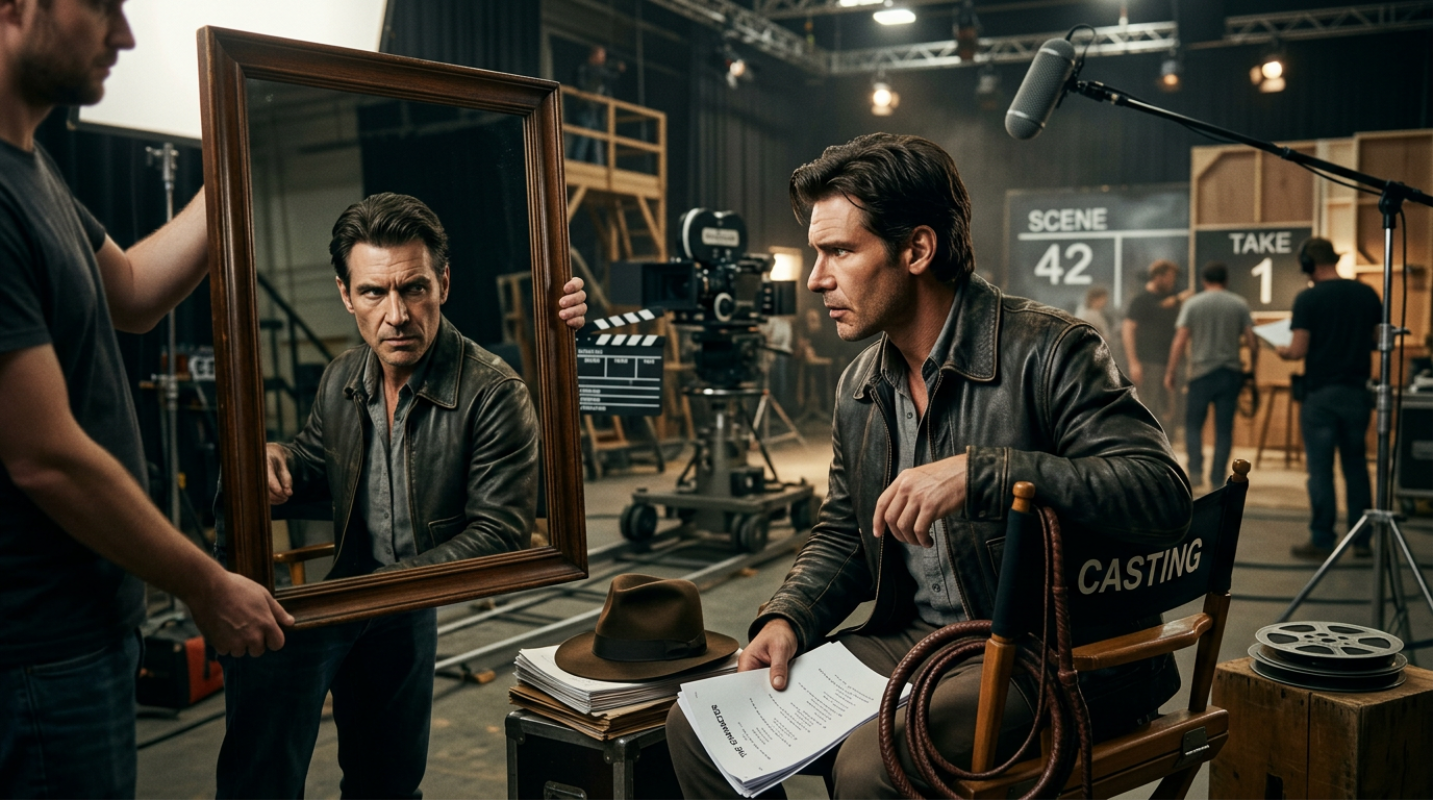
 (Image source: Gemini)
 Have you ever watched a movie and tried to imagine someone else in the lead role? It’s almost impossible, right? Try to picture anyone other than Keanu Reeves dodging bullets in a slow-motion green haze, or anyone besides Harrison Ford outrunning a giant boulder. These performances feel like they were written in the stars, but the truth is way more chaotic. The history of cinema is basically one giant game of musical chairs. One actor has a scheduling conflict, another wants too much money, and suddenly a role that defines a generation falls into the lap of someone who wasn't even on the original list. Casting is a weird mix of timing, ego, and luck. It’s the ultimate butterfly effect. If one person says "no," the entire cultural space shifts.
The Sliding Doors of Hollywood
You’ve probably heard the rumors about Will Smith almost playing Neo in The Matrix. It’s one of those stories that keeps coming back, especially after Smith posted that cryptic video on Instagram in early 2025, revisiting his 1997 decision. He chose Wild Wild West instead. Just think about that for a second. If Smith had taken the red pill, we would have seen the "Fresh Prince" version of the One.
Smith’s massive 90s superstar energy might have actually worked against the movie. Keanu Reeves brought a specific kind of "zoned-out" vulnerability that let the audience focus on the complex world-building rather than the guy in the sunglasses.¹ If Smith were there, it would have been a Will Smith movie. With Keanu, it became a philosophical masterpiece.
Then you have the Tom Cruise and Iron Man situation. Reports that resurfaced in late 2024 confirmed that Cruise was flirting with the role back when the rights were still at 20th Century Fox. The deal fell apart because Cruise’s fee was just too high for a superhero that, at the time, wasn't a household name.
If Cruise had signed on, we never would have seen Robert Downey Jr.’s incredible redemption arc. RDJ’s real-life struggles mirrored Tony Stark’s journey so perfectly that it anchored 22 films. Cruise is a legend, but his version of Stark would have likely been a polished, "Top Gun" style hero. We would have lost the grit and the soul that built the entire Marvel Cinematic Universe.
Casting Shapes the Room
Casting isn't just about finding one good actor. It’s about how that actor reacts to everyone else in the frame. Have you ever noticed how some movies just feel "right" the moment the characters start talking? That’s not just the script. It’s the alchemy between the people on screen.
Take the 2024 film Civil War. There’s a scene with a soldier that critics have called the most terrifying moment in modern cinema. That soldier was played by Jesse Plemons, but he was actually a last-minute replacement. His wife, Kirsten Dunst, who was already starring in the film, suggested him when the original actor fell through.
Plemons brought a quiet, polite menace that changed the entire tone of the movie. If a more traditionally "scary" actor had played that part, it might have felt like a standard thriller. Plemons made it feel like a nightmare you couldn't wake up from. It’s a perfect example of how a single casting pivot can turn a good movie into a haunting one.
We saw something similar with the Barbie movie. Can you imagine anyone else as Allan? Originally, Jonathan Groff was supposed to play the role, but he had to drop out due to scheduling. Michael Cera stepped in, and his "awkward outsider" energy turned Allan into a massive cult favorite. Cera didn't just play the part; he defined the vibe of the entire character in a way that probably wasn't even on the page.
Casting Changes Actually Saved Movies
Sometimes, the "original choice" for a role sounds like a total disaster in hindsight. We often think of the first choice as the "correct" one, but history shows that’s rarely the case. Studio executives and directors often have very different ideas about who should lead a film, and those mid-production pivots are what save the day.
Look at the 2023 Barbie movie again. Before Margot Robbie was attached, Amy Schumer was the original Barbie. She ended up leaving because of creative differences. Her version of the film involved Barbie as an inventor of Jell-O high heels. Although that sounds funny, it’s a far cry from the existential, billion-dollar phenomenon we got with Robbie.
Robbie’s casting allowed the film to go deeper and look at what it means to be human. If they had stuck with the original plan, we probably wouldn't be talking about Barbie as a cultural milestone today. It would have been just another mid-tier comedy.
Even in serious dramas like Oppenheimer, these small shifts matter. Glen Powell recently shared that he missed out on the role of Ernest Lawrence by a very slim margin. Josh Hartnett got the part instead and brought a grounded gravity to the role. Powell has that high-energy "Maverick" persona, which is great, but it might have felt too modern for a 1940s physics lab. Hartnett was the "vibe" the movie needed to feel authentic.
The New Era of Casting and the Luck of the Draw
As we move through 2026, the way movies are cast is changing. We’re seeing a shift away from the traditional "star vehicle" where one big name carries the whole thing. Recent high-budget flops have shown that audiences care more about the "vibe" and the franchise than just seeing a famous face.
The industry is also getting more technical. Nearly 45% of casting companies started using AI to help match actors to roles based on data patterns.² Although that sounds a bit cold, it’s meant to reduce those "near-misses" caused by human oversight. But honestly, do we want that? Part of the magic of movies is the weird, accidental nature of it all.
The Academy has even recognized how key this "sacred art" is by introducing a new Oscar for Best Casting, which will debut in 2026. It’s about time. Casting directors are the ones who find the "nebbishy" Dustin Hoffman for The Graduate or the "vulnerable" Keanu Reeves for The Matrix. They are the ones who see the potential in a "no" and turn it into a legendary "yes."
If you want to dive deeper into the "what could have been" of Hollywood, here are a few things you should check out
- The Rewatchables Podcast: They often have episodes dedicated to "casting what-ifs" and how different actors would have changed famous movies.
- MCU: The Reign of Marvel Studios: This book is a goldmine for stories about how the Marvel universe was almost cast very differently.
- Casting By: A great documentary that looks at the history of casting directors and their impact on the industry.
Why We Stay Obsessed with the What If
So why do we care so much about who almost played who? It’s because it reminds us that our favorite stories are fragile. One different decision, one delayed flight, or one contract dispute, and the movies that shaped our lives wouldn't exist in the same way.
There’s a certain serendipity in cinema. We like to think that these iconic performances were inevitable, but they were actually the result of a thousand tiny accidents. The fact that 90% of professional actors are unemployed at any given time makes these success stories even more miraculous. For every actor who becomes an icon, there are a dozen who were "this close" to the same fate.
Next time you’re watching a classic, take a second to imagine it with the "original" choice. It’s a fun exercise, but it usually just makes you appreciate the final version even more. Cinema history isn't a straight line; it’s a messy, chaotic web of "almosts" and "nearly-weres." And honestly, that’s exactly what makes it so perfect.


.jpeg)